

Choosing the right method for corporate training can significantly impact the efficiency and...
In 2026, the future-skills conversation has moved beyond simple upskilling. The strongest signals from global workforce research point in the same direction: employers need people who can combine AI literacy with analytical thinking, resilience, leadership, and strong communication.
Recent global jobs and learning reports show that a large share of today’s skills will change by 2030, and many employers already see skills gaps as a major barrier to transformation. AI and digital capabilities are rising fast, but human strengths such as communication, adaptability, and leadership remain essential.

That shift matters for global businesses. Workplace learning research shows that executives are increasingly concerned that employees do not yet have the right skills to deliver business strategy. The same research also shows that organizations investing seriously in career development are often better positioned to move forward with generative AI adoption.
For international teams, language is now part of that future-skills agenda. Research on multilingual workplaces shows that language-related misunderstandings remain common, especially in operational and international environments. At the same time, research on team performance shows that healthy teams depend on trust and communication. Put together, the message for 2026 is clear: corporate language training is no longer just about learning a language. It is about building communication readiness for modern work.What are future skills in 2026?
Future skills in 2026 are the abilities that help employees perform in fast-changing, AI-enabled, multicultural workplaces. They include AI literacy, critical thinking, adaptability, leadership, empathy, and the ability to communicate clearly across functions, cultures, and languages.
This is why employee development is being redefined. The question is no longer, “Did employees finish a course?” The real question is, “Can they contribute more effectively in meetings, collaborate across borders, give clearer feedback, and use AI without losing their human voice?”
Why corporate language training is changing
Traditional language learning focused on grammar, vocabulary, and general fluency. In 2026, that is not enough.
Today’s teams need business language training that helps people handle real business moments: presenting to stakeholders, writing concise updates, leading international calls, navigating cross-cultural nuance, and using AI tools to draft, refine, and adapt communication. Current workplace skills research continues to rank communication among the most in-demand capabilities in the age of AI.
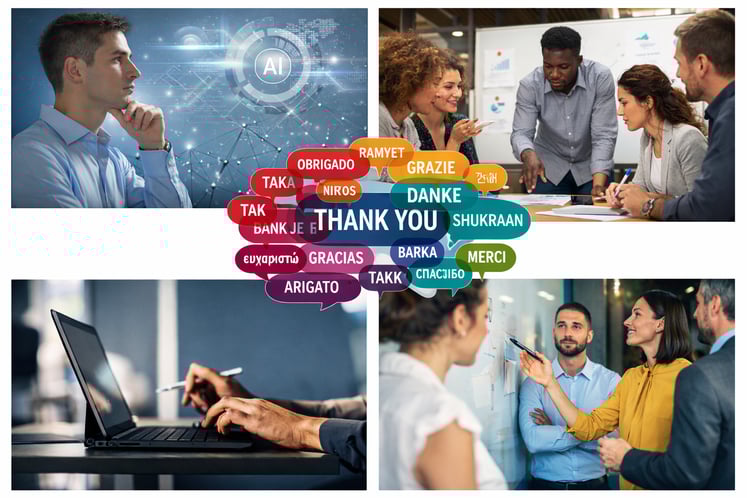
That is why the most effective custom language training for businesses now sits at the intersection of language, confidence, and performance. It is less about “speaking perfectly” and more about “communicating effectively in context.”
The new communication skill stack for global teams
1. AI-assisted communication
Employees increasingly use AI to draft emails, prepare presentations, summarize meetings, and support customer communication. But better tools do not automatically create better communication. Teams still need judgment, tone awareness, and audience sensitivity. Recent workplace research makes it clear that every employee needs a basic level of AI literacy, along with the ability to work effectively in human-AI collaboration.
2. Cross-cultural clarity
In global teams, misunderstanding is often not about grammar. It is about tone, expectations, directness, silence, feedback style, and decision-making habits. Modern corporate language training should teach employees how to adapt their message across cultures, not just translate words.
3. Plain-language business writing
As work becomes more digital and more global, clarity becomes a competitive advantage. Employees need to write messages that are short, clear, and easy to act on. That applies to emails, chat messages, reports, customer updates, and AI prompts.
4. Speaking confidence in meetings
Many employees know enough English or another business language to do their job, but still hesitate in live conversations. The gap is often confidence, speed, and spontaneous interaction. Strong communication skills training helps employees ask questions, challenge ideas respectfully, contribute in meetings, and speak up earlier.
5. Team collaboration across languages
The future of work is team-based, not individual-only. Research on high-performing teams continues to show that trust and communication are critical to team health. This is where corporate team building and communication practice can reinforce each other through simulations, role-plays, and collaborative projects.
How to enhance language training in 2026
To enhance language training, businesses need to move from generic programs to role-based, measurable learning experiences.
First, training should be tied to business situations. Sales teams need persuasive conversations. Managers need feedback and coaching language. Customer-facing teams need clarity, empathy, and speed. HR teams need inclusive, culturally aware communication.
Second, training should combine human interaction with AI-enabled practice. Employees can rehearse presentations, refine writing, and prepare for meetings with digital support, then build confidence through live coaching and conversation.
Third, progress should be measured by performance, not attendance. The best business language training shows impact in meeting participation, presentation quality, customer interactions, manager confidence, and cross-team collaboration.
Finally, learning should support broader employee development. Recent workplace learning reports continue to show that career development and learning are most effective when they are closely connected, especially in organizations preparing for a more AI-driven future.
From language training to business performance
In 2026, leading companies are treating language and communication as business infrastructure.
They are not asking whether employees need “another course.” They are asking whether teams can communicate clearly under pressure, collaborate across borders, and represent the business confidently in front of clients, colleagues, and partners.
That is the real evolution of corporate language training. It is becoming a strategic tool for collaboration, confidence, adaptability, and growth.
For HR and L&D leaders, this creates a major opportunity. A well-designed program can improve communication, support AI adoption, strengthen inclusion, accelerate employee development, and help teams work better together. In other words, it turns training into capability.
Conclusion
The most relevant future-skills topic for 2026 is not just AI. It is the combination of AI literacy and human communication.
That is why custom language training for businesses matters more than ever. It helps employees do more than learn vocabulary. It helps them think clearly, collaborate globally, communicate with confidence, and contribute at a higher level.
For organizations investing in the future, that is where language learning becomes business value.
Ready to empower your employees with strategic training? Download our whitepaper “Evolving HR Strategies- Talent, Retention, and Inclusion” to learn more. Contact us today to schedule a consultation and embrace the future of training.